ScoutLayer materially updated
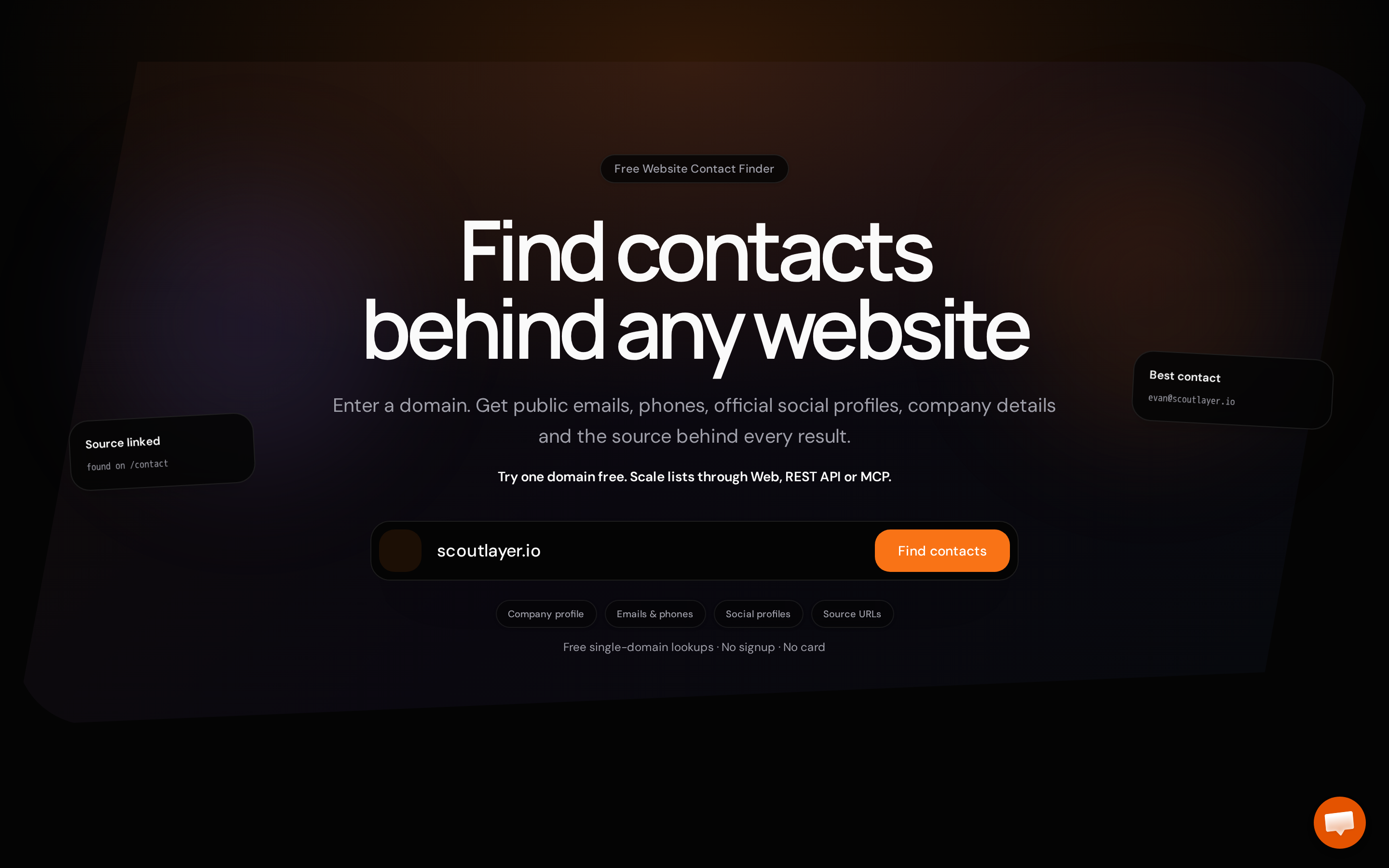
Find contacts behind any website
Paste a URL. An agent crawls the product, screenshots it, and writes the listing in about thirty seconds, then re-reads it weekly.
Ordinary liquid: launch-day noise, ranked by whoever showed up.
Discovery is measurement. Nothing is ordered by votes, clicks, or traffic, so there’s nothing to game.
Weekly re-crawls, free. Real change resurfaces the product.
Every verdict links to the Atlas data behind it: verified, failed, or unverifiable.
Real events in the order they happened: listed, claimed, updated, λ crossed.
Atlas renders your site in a real browser, captures the pages that matter, extracts facts against a schema, and drafts the listing. You get an editable draft; nothing is auto-published.
Atlas writes it; nothing is published until you have read every field and said so.
If the crawl fails, nothing is charged for it and the job says so itself.
Every field is editable before publish, and after it.
Retrieval runs over the catalog we measured ourselves — full text and vectors, fused. The answer can only cite what came back. When nothing fits, it says so.
Three products in the catalog do this. Murmur is the closest match — it records a memo, transcribes it, and drafts the changelog entry for you to approve. Marginal and Sundial each cover part of it; nothing in the catalog does it for a self-hosted repo yet.
“Nothing in the catalog does this yet” is a valid answer. We never invent a product to fill the page.
Browsing, filters, comparisons and every product page are free and stay that way. Only the machine work is metered.
The same catalog is exposed over REST and MCP, so the assistant you already use can answer from it.
A reading is a measurement with evidence: Atlas checks uptime, re-reads pricing, tests features. Verdicts are verified, failed, or unverifiable, each with its data.
In physics, λ is where helium turns superfluid and flows without friction. Here it is the moment a product first sustains real outbound traffic. It is earned from actual visitors, and there is no way to buy it or ask your friends for it.
No product has crossed λ yet. When one does, this is where its real outbound clicks will appear.
The catalog is a first-class machine surface: a keyed REST API, and an MCP server so the assistant answering “what should I use for this?” reads ground truth.
Every public page ships JSON-LD, and the catalog describes itself in llms.txt for crawlers that prefer prose.
100 free credits a month, and packs that never expire. Monthly credits spend first, holds release when a job fails, and every movement is on a ledger you can read. No countdown timers; expiry is stated plainly.
Free, every month. They spend first and do not roll over.
No expiry, ever. Spent only once the monthly ones are gone.
Deleting a listing is free and permanent: one confirmation, no retention offer.
About thirty seconds to a listing. Claiming and deleting are free.